
Disclosure: Oak Cliff Design earns a small commission when you buy through our links, at no extra cost to you. As an Amazon Associate, we earn from qualifying purchases. Read our editorial standards.
There is a room in your house that nobody sees you in.
It might be a room with a door. It might be a corner of the bedroom where the light comes in low around six in the evening. It might be the end of a hallway where you put a chair because it fit, and then you sat in it one night, and then you sat in it the next night, and now it is yours.
This is the room you do not stage. You do not photograph it. You do not tidy it before people come over, because people do not come to this part of the house. It is the room that exists entirely for the person who lives here.
I have been thinking about this room for a long time. Not as a design exercise but as a question: what happens when you stop decorating for an audience and start building a room for the person you actually are at nine o’clock on a Tuesday?
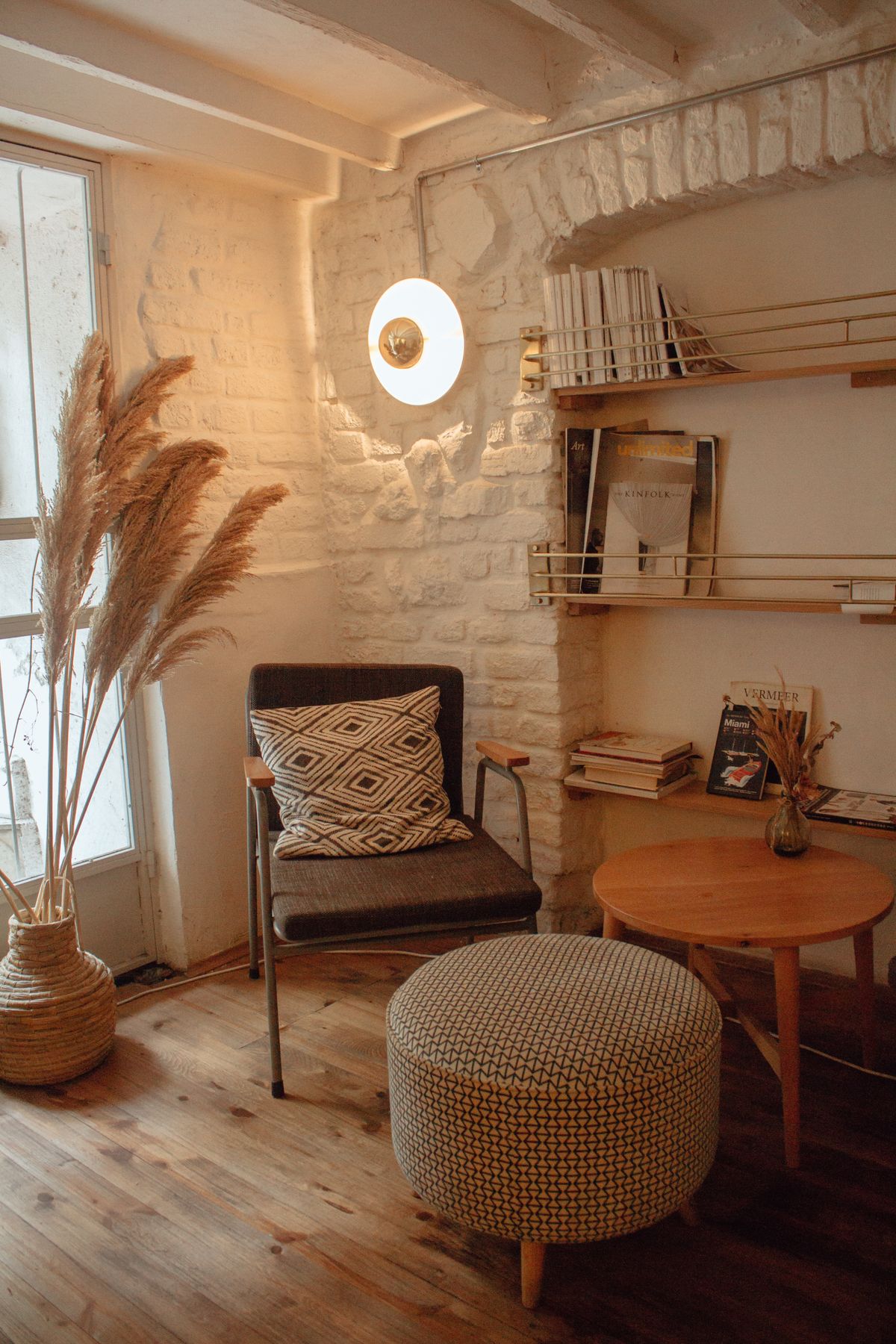
The answer, I think, involves three things. A chair. A surface. And one deliberate source of light.
The chair that fits your body, not your feed
The chair in this room should not be the prettiest chair you own. It should be the one your body has memorized. The one where your shoulders drop two inches the moment you sit down. The one that has a crease in the cushion shaped exactly like you, because it is.
I have sat in a lot of chairs for this site. Accent chairs, dining chairs, reading chairs, lounge chairs. The ones I write about are the ones I would buy. But the chair in my own room, the private one, is a walnut-legged leather lounge chair that I found at an estate sale four years ago. The leather is cracked on the left armrest. The cushion sags slightly to the right. It is the best chair I have ever sat in, because it is mine.
You do not need an estate-sale find. You need a chair that passes one test: can you sit in it for two hours without shifting? Not twenty minutes in a showroom. Two hours, with a book, after a long day.
If you are starting from scratch, I would point you toward the mid-century lounge chairs with ottomans in the $400 to $800 range. Not the Eames replica (too stiff for long sits, despite the looks). Something with a high back and real cushion depth. We reviewed seven reading chairs under $800 last year, and the ones that survived the two-hour test were not the ones that photographed best. They were the ones that disappeared under you.

Throw a throw blanket over one arm. Not for the look. For the Tuesday at 10 p.m. when the house gets cold and you do not want to get up.
The surface within arm’s reach
Every good chair needs a surface next to it. Not a coffee table across the room. A surface you can reach without leaning forward. This is not a design preference. This is physics. If you have to stand up to set down your coffee, you will stop sitting in the chair.
The surface can be a side table. It can be a stack of design books that you never got around to shelving. It can be a C-shaped end table that slides under the chair arm. What it cannot be is absent.
I use a small walnut side table that is exactly 22 inches tall, which puts it one inch below the arm of my chair. On it, at any given time: a mug, a book I am halfway through, a small ceramic tray for my watch and phone, and nothing else. The nothing else is important. This surface is not a shelf. It is not a display. It is a workbench for the single activity that happens in this corner: being still.
If you are buying one, look for something with a round top. A round table next to a chair has no sharp corners to catch your hip when you stand up in the dark, which you will do, because you fell asleep in the chair. This will happen more than you think.

2700 Kelvin and the case for one lamp
The light in this room should come from one source. Not overhead. Not a floor lamp across the room. One lamp, close, at roughly the height of your shoulder when you are sitting down.
There is a reason for this. A single warm light source at shoulder height creates a pool of light that ends at the edges of your chair. Everything outside that pool goes dark, or close to it. The room shrinks. The world shrinks. It becomes the size of a book, a mug, and whatever you are thinking about. This is the point.
The color temperature matters. You want 2700 Kelvin. Not 3000K, not 4000K, and certainly not the 5000K “daylight” bulbs that make every room feel like a dentist’s office. At 2700K, wood looks like wood. Leather looks warm. Your hands look like hands, not like something under fluorescent examination. A Philips 2700K LED costs four dollars and will change the way you feel in a room. I am not exaggerating.
For the lamp itself, you want something with a fabric shade, not metal, not glass. A fabric shade diffuses the light so there is no hard edge between the lit circle and the dark room. The transition is soft. You notice it if you pay attention, and you stop noticing it the moment you start reading, which is the whole point.
We covered the best table lamps under $150 in detail. Any of the top three would work in this corner. If you want a desk lamp instead because the surface is tight, the Tomons swing arm at $40 does the job. But a table lamp with a fabric shade will always win in a room built for quiet.

What belongs on the shelf nearby
If there is a shelf within sight of this chair, it should hold the things you actually reach for. Not the complete works of anyone. Not the books you think you should have read. The books you have read twice, and the one you are about to read again.
I keep eleven books on mine. Ten that have earned their place, and one that is on probation. The probationary slot rotates every month or so. The permanent ten do not change often. When one comes off, it is because I read something that made me see it differently, and that is rare.
You do not need my list. You need yours. But if you are starting a shelf from nothing and you want ten design books that will hold up under re-reading, we wrote that list. The Bradbury and the Wegner monograph are the two I would start with. The rest follow once you know what pulls you in.
Between the books, a pair of heavy bookends and one small ceramic vase, empty or with a single dried eucalyptus stem. That is it. A shelf that looks crowded is a shelf that is trying to impress someone, and nobody is here to be impressed. This room is not for them.
The objects that prove you were here
Over time, this corner accumulates evidence. A ring on the side table from a mug you set down too many times. A dent in the throw blanket from the way you fold it when you get up. A bookmark three-quarters of the way through a book you have been reading slowly on purpose because you do not want it to end.
These marks are not damage. They are data. They are the physical record of a person who sat in one place, on purpose, repeatedly, and paid attention to something. In a house full of rooms designed for other people, designed for photographs, designed for the version of yourself that entertains, this corner is the room that proves the other version exists. The one who reads. The one who stares out the window for ten minutes and does not reach for the phone. The one who sits.
Mid-century modern, at its best, was never about the furniture. It was about the idea that a well-made room could make a person’s daily life a little more deliberate. That a chair could be shaped to a body. That a lamp could be tuned to an hour of the evening. That a shelf could hold exactly what matters and nothing else. The designers who made the pieces we now collect were not thinking about resale value or Instagram grids. They were thinking about the room nobody sees you in.
Build that room. Not for anyone. For Tuesday.
Where to start
If you are building this corner from scratch, here is the short list:
- The chair: A cushioned accent chair or reading chair you have sat in for two hours. Budget: $300-800.
- The surface: A round walnut side table, 20-24 inches tall. Budget: $50-150.
- The lamp: A table lamp with a fabric shade and a 2700K bulb. Budget: $40-120.
- The blanket: A cotton throw in mustard or olive, heavy enough to stay draped. Budget: $30-55.
- The shelf: Optional. But if you have one: bookends, ten books, one vase.
Total: roughly $500 to $1,200. Less than a single designer piece. Enough to build a room that is entirely, quietly, yours.
Shop mid-century reading nook essentials on Amazon →
Related reading
- A walnut shelf, a soft lamp, and ten books worth living with
- The 7 best mid-century reading chairs under $800
- 8 throw blankets under $60 that make any sofa look finished
- The best mid-century table lamps under $150
- The 6 best mid-century bookends under $40
Last updated June 29, 2026.