
Our editors independently select every product we feature. When you buy through our links, Oak Cliff Design may earn a commission at no cost to you. How we’re supported
The bedroom is where mid-century modern is easiest to do well and easiest to abandon halfway. Easiest to do well because the room only asks for five or six decisions, and the style’s whole argument is that fewer, better pieces beat a matched set. Easiest to abandon because nobody sees it. The living room gets the walnut credenza and the good lamp; the bedroom gets whatever was left over, a mattress on a frame with a fabric skirt hiding the legs, and a nightstand that came in a flat box in 2019.
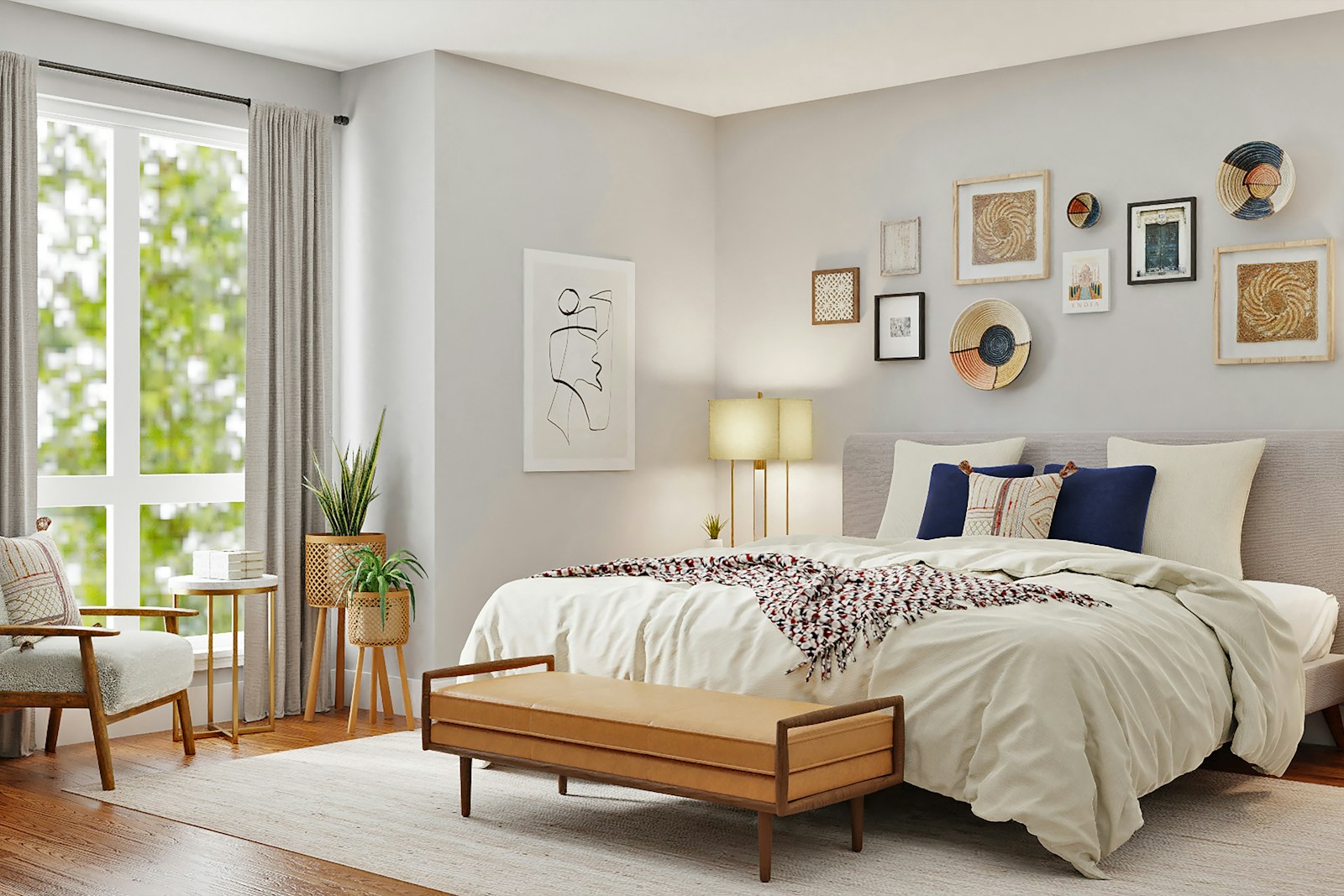
That is a shame, because the bedroom is the room the style was arguably designed for. Mid-century designers were obsessed with low horizontal lines, with lifting furniture off the floor so a small room reads larger, and with warm wood doing the work that ornament used to do. All three of those instincts pay off hardest in a room where the largest object is a rectangle you lie on. This is the complete guide to building a mid-century modern bedroom: what each piece is actually doing, which one to buy first, and the clearances and proportions that make the difference between a styled room and a room that just has a bed in it.
What makes a bedroom mid-century modern
Strip away the shopping for a minute. Five principles carry the look, and if you get these right the specific pieces matter much less than you think.
Low and horizontal. Mid-century beds sit lower than their traditional equivalents, usually 10 to 14 inches to the top of the platform rather than 18 or more. The headboard is wide and shallow rather than tall and tufted. The dresser is long and low rather than a tower. The eye travels sideways across the room, which is what makes a normal ceiling feel higher than it is.
Legs you can see. Tapered legs, splayed slightly, with the floor visible underneath. This is the single most reliable tell of the style and the one most often lost to a bed skirt or a box-base platform. Visible floor under the bed, the nightstands, and the dresser is worth more to a small bedroom than any amount of clever storage.
Warm wood, and only one or two of them. Walnut is the era’s default, teak its warmer cousin, white oak the lighter modern read. Pick one to lead and let a second play a supporting role. Our walnut vs teak vs white oak guide covers how each one ages and which finishes actually match across brands, which is the part that trips people up when the bed and the dresser come from different places.
A warm, quiet palette with one or two accents. Cream, oatmeal, warm white, and wood carry the room. Then one or two era colors, repeated at least twice each so they read as a decision. More on this below.
Negative space. The era’s furniture was designed to be seen from all sides, with air around it. A bedroom that follows the other four rules and then fills every corner will still feel wrong. Leave a wall empty.
Start with the bed: low, wide, and lifted
The bed is 60 to 70 percent of the visual mass in the room, so it sets the ceiling on how good the room can get. Three things to look for.
The base. A platform with visible tapered legs, ideally in the same wood family you plan to use for the dresser. If the frame you already own has a solid base or a skirt, you can usually swap the legs or remove the skirt and get most of the way there for very little money. Upholstered headboards are period-correct as long as they are low and wide, in a flat weave (boucle, wool, tight linen) rather than a plush velvet, and the frame under them still shows legs.
The height. Aim for a mattress top around 24 to 25 inches off the floor once the mattress is on. Lower than 20 and getting in and out becomes a project; higher than 28 and the room loses the horizontal read that makes the style work.
The headboard width. It should be at least as wide as the mattress and ideally a few inches wider on each side. A headboard narrower than the mattress is the fastest way to make an expensive bed look like a budget one.
If the bedroom doubles as anything else, or the footprint is genuinely tight, the bed is also the piece worth rethinking entirely. Modern wall beds are nothing like the spring-loaded units people picture, and our guide to the best modern murphy beds by room type breaks down vertical, desk-combo, and sofa-combo mechanisms, including a no-mount cabinet bed for renters. The broader murphy beds and wall beds guide covers the mounting and clearance questions before you commit.
The nightstands, and why they set the tone
Nightstands are the cheapest piece in the room and they do a disproportionate amount of the styling work, because they sit at eye level when you are standing and they frame the bed. Get these right and a mediocre frame stops mattering.
Height: match the mattress top, or up to two inches above it. Most mid-century nightstands run 22 to 26 inches, which is the right window for a standard platform bed.
Depth and width: 16 to 20 inches deep is the sweet spot. Wider than 24 inches and a pair starts to crowd a queen in a normal bedroom.
Details that read as mid-century: a fluted or reeded drawer front, a tapered leg, a recessed or slim brass pull, and a top edge with a slight radius rather than a hard square. Avoid chrome hardware and anything with a raised molding.
They do not have to match each other, and in the era they frequently did not. A pair reads calm and hotel-like; a mismatched pair (same wood tone, different silhouette) reads collected. What they should not do is differ wildly in height. Our roundup of the best mid-century nightstands under $200 covers seven options across fluted, solid wood, and walnut-with-brass, with the height and depth spec on each. If your room is tight enough that a proper nightstand does not fit, a small mid-century side table at the right height does the same job.
The dresser is the room’s one big wood moment
If the bed sets the proportion, the dresser sets the temperature. It is usually the largest uninterrupted expanse of wood in the house after the credenza, and it is the piece people notice when they walk in.
Low and wide beats tall and narrow whenever the wall allows it, for the same reason the bed sits low: a long horizontal line makes the room read wider and the ceiling higher. A nine-drawer lowboy at 60 inches wide will transform a bedroom in a way a 30-inch chest never will. Reserve the tall chest for genuinely narrow rooms, or for the second dresser in a shared bedroom.
The top of the dresser is also the room’s best surface for a vignette, and the easiest place to get the styling wrong by putting six things on it. Three objects at three heights: a mirror or a piece of art leaning against the wall, one ceramic vase, and a small tray for the things that would otherwise live in a pile. That is the whole formula.
Our guide to the best mid-century dressers under $600 covers the walnut lowboys and fluted fronts worth buying new. If you would rather hunt for the real thing, buying used mid-century furniture online walks through where dressers actually turn up and what to inspect, and how to tell real mid-century furniture from reproductions covers the drawer construction and maker’s marks that separate a 1962 Broyhill from a 2022 lookalike. A vintage teak dresser that has gone gray and dry is usually a weekend of work away from spectacular; our teak cleaning and restoration guide covers the process.
Light the bedroom in three layers
This is where most bedrooms fail, and it is the cheapest thing to fix. A single ceiling fixture on a wall switch, which is what most bedrooms ship with, produces flat overhead light at exactly the moment you are trying to wind down. Mid-century interiors were lit from multiple low sources, and the bedroom is the room where that matters most.
Layer one, ambient. Whatever is overhead. If it is a builder-grade dome, swapping it for a simple globe or a small mid-century pendant is a 20 minute job with an outsized payoff. Then, and this is the important part, put it on a dimmer. Our dimmer switch guide covers which type works with which bulbs, and the same logic applies here.
Layer two, bedside. A pair of mid-century table lamps is the default, and the rule is that the bottom of the shade should sit at roughly your eye level when you are sitting up in bed, usually 24 to 28 inches of total lamp height on a standard nightstand. If the nightstand surface is precious, wall-mounted swing-arm sconces free it up entirely and are more period-correct than people expect.
Layer three, accent. One low warm source somewhere else in the room: a small lamp on the dresser, an uplight behind a plant, or a floor lamp in the reading corner if you have one. This is the layer that makes the room feel finished at night rather than merely lit.
Across all three, stay at 2700K and use warm-dim bulbs where you can. A 4000K bulb in a walnut room turns the wood gray and undoes the whole palette.

Ground it with a rug, and put it in the right place
Bedroom rugs are placed wrong more often than any other rug in the house. The goal is simple: your feet should land on wool, not floor, when you get out of bed.
Slide the rug under the bottom two thirds of the bed, starting just in front of the nightstands, and let it run 18 to 24 inches past each side and past the foot. For a queen that is an 8×10. For a king, a 9×12. A 5×8 floating at the foot of the bed is the classic mistake, and it makes the bed look like it is drifting.
For texture, a low wool pile or flatweave in a warm neutral does the most work under a busy bed. If the bedding is plain, this is a good place for a geometric. Our roundup of the best mid-century rugs under $400 covers both directions, including the shag options that are more period-correct in a bedroom than anywhere else in the house.
If the room is carpeted and you cannot change that, a smaller flatweave layered on top still works, and matters less than it would on hardwood.
The wall above the bed
You have three good options and one bad one.
One large piece. The most reliable. It should span roughly two thirds of the bed’s width and hang so its bottom edge sits 6 to 10 inches above the headboard. Abstract, a landscape, or era-appropriate geometry all work; our mid-century wall art guide covers the prints and formats that hold up at scale.
A tight grid of three or four. Same total footprint, same two-thirds rule, spaced 2 to 3 inches apart with matching frames. Reads more graphic and suits a smaller bed.
A round mirror or a sunburst. Warmer than art, and it bounces the bedside lamps around at night. See mid-century mirrors for the sunburst and round options.
The bad option is a gallery wall of many small frames above the bed. It fights the headboard for attention and it never settles. Save the gallery wall for the wall opposite, where you can see it properly.
Texture: bedding, a throw, and something alive
A mid-century bedroom that follows every rule above can still feel like a rendering, and the reason is almost always texture. Three cheap fixes.
Bedding in a flat, natural weave. Washed linen or a good percale in cream, oatmeal, or warm white. Skip the shiny sateen. The wrinkles are the point: they keep the room from reading as staged.
One throw and two or three pillows, maximum. Fold the throw across the bottom third at an angle rather than squaring it off. Our throw blanket roundup covers the geometric and wool-blend options, and mid-century throw pillows covers the accent colors. Two euro shams, two standard pillows, and one lumbar is a complete bed. Anything past that is a pile you move to a chair every night.
Something alive. A snake plant, a rubber tree, or a pothos on a tapered plant stand. One is enough, and the stand matters as much as the plant because it adds the leg line again at a different height.
Get the palette right
The formula that works in the living room works here, with one adjustment: the bedroom can go darker and moodier than the rest of the house, because you are mostly in it at night.
Start with a warm neutral base on the walls (warm white, oatmeal, a soft greige with a yellow rather than blue undertone) and let the wood be the color. Then choose one or two accents from the era palette: mustard, olive, muted teal, burnt orange, or a dusty clay. Repeat each accent at least twice, on opposite sides of the room, so it reads as a plan. A mustard throw and a mustard book spine on the nightstand is a plan; a single mustard pillow is an accident.
If you want a painted accent wall, put it behind the bed and nowhere else, and go muted rather than saturated. Olive, clay, and muted teal are the three that almost always work in a bedroom. Our complete guide to mid-century modern color palettes has the specific paint combinations and the undertone traps to avoid, which is the part that separates a warm room from one that goes slightly green under lamplight.
One thing to actively avoid: cool gray. It was everywhere for a decade and it does walnut no favors, pulling the wood orange and the whole room cold.
Layout and proportion: the clearances that matter
Almost every bedroom problem that feels like a taste problem is actually a clearance problem. The numbers:
- 24 to 30 inches of walking space on each side of the bed, and at the foot. Below 24 and the room feels tight no matter what is in it.
- 36 inches in front of the dresser, so drawers open fully and you can stand back from them.
- Center the bed on its wall if at all possible, even at the cost of a little clearance on one side. An off-center bed is the thing people cannot name but always feel.
- Do not push the dresser into the corner. Pull it 3 or 4 inches off both walls if the room allows. The gap is what makes it read as furniture rather than built-in.
- Nightstand to bed gap: 2 to 6 inches. Touching is fine, but a foot of gap breaks the frame.
If the numbers do not work, the fix is almost always a smaller bed rather than smaller everything else. A queen with proper clearance beats a king with none, and in a room under about 11 by 11 feet that trade is usually worth making.
The small bedroom version
Everything above still applies, with three adjustments.
Go leggier, not smaller. Visible floor under every piece is what buys the illusion of space. A leggy 20-inch nightstand reads lighter than a 16-inch cube that sits on the floor.
Move light off the surfaces. Wall sconces or a small clip lamp free up the nightstand top, which in a small room is most of your usable surface.
Go vertical exactly once. One tall narrow piece (a chest, a slim bookshelf) draws the eye up, and everything else stays low. Two tall pieces and the room closes in.
For rooms that have to do double duty, our guide to space-saving mid-century furniture for small apartments covers the nesting, folding, and wall-mounted options, and a wall bed remains the single biggest footprint win available. If the bedroom is also the office, a compact mid-century desk and a proper office chair will serve you better than a laptop on the dresser.
Five mistakes that kill the look
1. Buying the matched bedroom set. Bed, two nightstands, dresser, and chest all in one finish from one catalog is the fastest way to a showroom. The era’s own rooms were assembled over time. If you buy a set, break it up: swap one nightstand, or put the chest in another room.
2. Hiding the legs. Bed skirts, box bases, and storage drawers that run to the floor all cancel the defining feature of the style. If you need under-bed storage, use flat boxes that sit back from the edge and stay in shadow.
3. One overhead light, no dimmer. Covered above, and worth repeating because it is the cheapest fix with the biggest return.
4. The floating rug. A 5×8 at the foot of a queen. Either commit to an 8×10 under the bed or skip the rug and put runners on each side.
5. Too many small objects. Mid-century rooms are sparse. Two things on each nightstand, three on the dresser, one large piece on the wall. If the room feels off and you cannot say why, remove five objects before you buy anything.
Shop the bedroom by budget
If you are starting from a mattress on a frame, the order of operations that gets the most visible change per dollar is: nightstands and lamps first (under $300 for the pair with bulbs, and they change the room immediately), then the rug, then the bed base, then the dresser last, because it is the piece most worth waiting to find used.
That order is deliberate. The dresser is the most expensive piece and the one where a vintage find beats anything new at the same price, so it rewards patience. The nightstands and lamps are cheap, in your eyeline every night, and available now.
For a comparable shopping list in the other main room, our mid-century living room budget guide builds a complete room at $1,500 and $3,000, and the pacing logic transfers directly.
Frequently asked questions
What makes a bedroom mid-century modern?
A low, wide bed with visible tapered legs, warm wood tones (walnut first, then teak or white oak), horizontal lines, and furniture that sits away from the wall enough to breathe. The palette stays warm and quiet: cream, oatmeal, and wood, with one or two era accents like mustard, olive, teal, or burnt orange. Restraint matters more than any single piece, and the floor staying visible under the furniture is what separates the look from generic modern.
What color should I paint a mid-century modern bedroom?
Warm white or a soft oatmeal on three walls is the safest base, because it lets the wood be the color. If you want one painted wall, put it behind the bed and choose a muted era shade: olive green, muted teal, or a warm clay. Avoid cool grays and stark bright whites, which turn walnut and teak orange and flatten the whole room.
How high should nightstands be next to the bed?
Match the top of the nightstand to the top of the mattress, or go up to two inches above it. Most mid-century nightstands land between 22 and 26 inches tall, which suits the 24 to 25 inch mattress height of a standard platform bed. A nightstand that sits well below the mattress makes the bed look like it is floating away from it, and one that towers over it reads as a filing cabinet.
Where does the rug go in a bedroom?
Slide it under the bottom two thirds of the bed so it starts just in front of the nightstands and extends 18 to 24 inches past each side and the foot. For a queen that usually means an 8×10, and for a king a 9×12. A small rug floating at the foot of the bed is the single most common bedroom rug mistake, because your feet land on bare floor exactly where you get out of bed.
How do I get a mid-century bedroom in a small room?
Buy fewer, leggier pieces. A platform bed with open space underneath, wall-mounted sconces instead of table lamps, and one tall narrow dresser instead of a low wide one will all make the floor read as larger. In a studio or a guest room that doubles as an office, a wall bed folds the whole footprint away during the day, and modern mechanisms lower with two fingers rather than the spring-loaded units people remember.